


Here’s a conversation that happens at almost every hospital and health system we talk to.
The marketing team wants to build awareness. The CFO wants measurable ROI. The clinical team has underutilized service lines. Paid search is the compromise: it’s trackable, it’s attributable, and every click feels like proof that the money is working. So the budget tilts toward Google. Then it tilts more. Pretty soon, 60 or 70 or even 100 percent of the digital spend is going to search campaigns, and everyone’s looking at click-through rates like they’re the only number that matters.
We get it. Search is comfortable. It’s the channel where you can draw a straight line from dollar spent to appointment booked. When you’re trying to connect patients with specific services, that clarity is genuinely appealing.
There’s just one problem: It only works on people who are already looking for you.
Search Captures Intent. It Doesn’t Create It.
Think about how patients actually choose a healthcare provider. It’s not: feel a symptom, Google it, click an ad, book an appointment. That’s the version that fits in a marketing dashboard. The real version is messier and slower.
A patient drives past your hospital every day on the way to work. They see your name on a billboard, then again on a bus shelter near the grocery store. A few weeks later, they’re scrolling Instagram and your ad shows up: something about a new women’s health center. They don’t click. They keep scrolling. A month after that, they’re on WebMD at 11 pm reading about knee pain that won’t go away (we’ve all been there, Googling symptoms in our pajamas), and your hospital’s name appears alongside the clinical content. They still don’t click. But now they’ve seen you four times in four different contexts.
Then one morning, their knee finally wins the argument. And when they sit down to find an orthopedic specialist, they don’t type “orthopedic surgeon near me.” They type in “HOSPITAL NAME + orthopedics.”
That search was the last thing that happened. But it wasn’t the thing that made the decision. Every touchpoint before it did the actual work: building familiarity, establishing trust, making your hospital the name that surfaced when the need became real.
A hospital or health system running search-only is showing up at the finish line of a race it didn’t run. You’re paying to be visible at the moment of decision, but nobody did the work of building the trust and familiarity that shaped that decision in the first place.
The Alternative Isn’t Complicated. It’s Connected.
When we build digital marketing strategies for hospitals and health systems, we think about it as an ecosystem, not a channel list. Every channel has a specific job at a specific stage of the patient journey, with its own success metric. Nothing runs in isolation. The channels amplify each other.
This isn’t “omnichannel” as a buzzword. It’s more like a relay team: each channel runs one leg of the race really well, and hands off to the next. Here’s what that looks like.
1. Community Visibility: The Primer
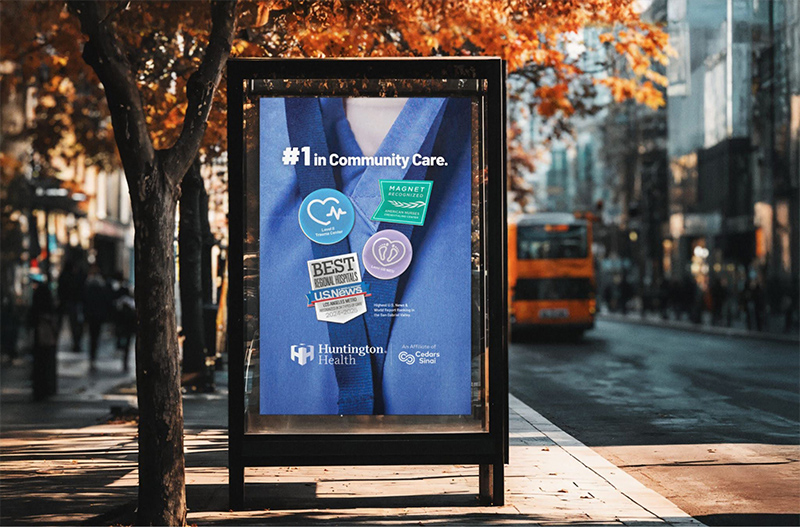
Digital out-of-home and traditional placements (billboards, transit, large-format digital screens in high-traffic areas) do something that no other channel can do: they put your health system into daily life before anyone has a health need.
This is the layer most healthcare marketers undervalue because it’s the hardest to attribute. Nobody taps a billboard. But community visibility is the foundation everything else builds on. You can’t search for a health system you’ve never heard of. You can’t recognize a programmatic ad for one you’ve never seen before.
And this layer goes beyond paid placements. Sponsoring the local 5K, advertising in community publications, showing up at neighborhood health fairs: these show that your organization is part of the community, not just located in it. That kind of authentic local presence builds a different kind of trust than any digital ad can. It says: we live here too.
It’s a bit like a primer coat when you’re painting. What it does on its own is nice, but what it’s really doing is building the foundation for the rest of your marketing efforts to be successful.
What you can measure: Audience reach and penetration within your service area.
2. The Always-On Pulse: Programmatic Display
Programmatic is the connective tissue of a hospital and health system digital marketing strategy. It delivers high-frequency, hyper-local impressions across websites and apps, keeping your system visible between the moments when a patient is actively thinking about healthcare.
This is the layer that makes your brand feel present in your patients’ digital lives. A patient reads a health article on the local news site: there you are. They check the weather app: there you are. They browse a recipe blog for weight loss tips: there you are. These impressions are unlikely to convert directly. All of them build the kind of quiet familiarity that converts later, when the need arises.
Programmatic also supports brand lift studies, which let you compare exposed audiences against unexposed ones and measure whether your campaign is actually shifting perception.
3. Trust at the Research Moment: Contextual Medical Content
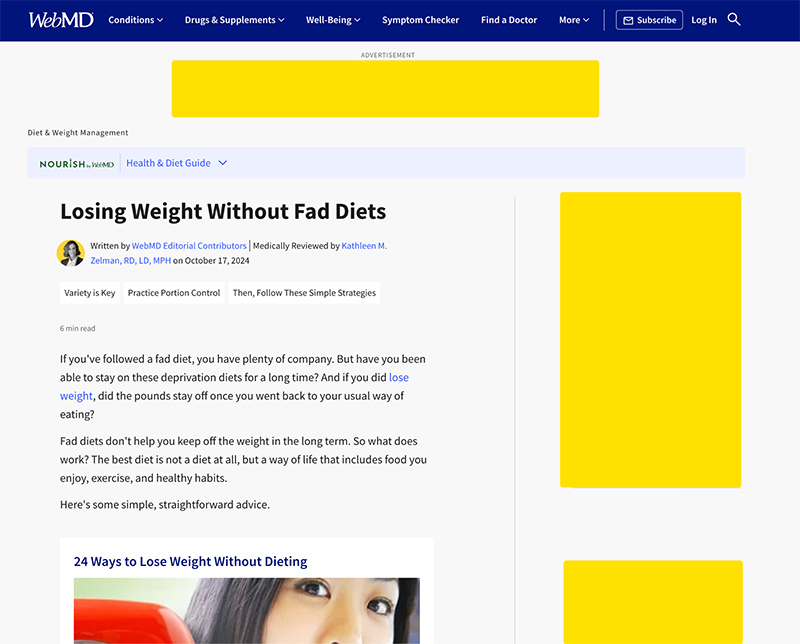
There’s a moment in every patient journey where someone is actively reading about a condition, a symptom, or a treatment option. They’re on WebMD, Healthline, or a medical journal site. They’re not shopping for a hospital yet. They’re looking for information they can trust.
Being present in that environment (not as a banner ad on a random site, but alongside credible medical content) does something no other channel can do. It borrows trust from the context. When a patient sees your hospital’s name next to the clinical content they’re reading at their most vulnerable moment, it registers differently than a social ad or a search result.
4. Passive Discovery: Social Media

Social media keeps your health system in the feed as a community presence. It helps your hospital or health system stops feeling like an institution and starts feeling like a neighbor.
Facebook and Instagram are particularly effective here because the targeting is strong (you can reach specific demographics within specific ZIP codes) and the formats let you show the human side: video tours of new facilities, physician spotlights, community health events, patient stories.
The same community-first instinct that makes local sponsorships powerful works here too. When your social feed looks like it was made by people who care about the neighborhood (not a corporate comms department), patients notice.
This won’t drive too many appointments directly on its own, but it does keep your system top-of-mind before active searching begins, and drives positive community sentiment.
5. The Last Mile: Search
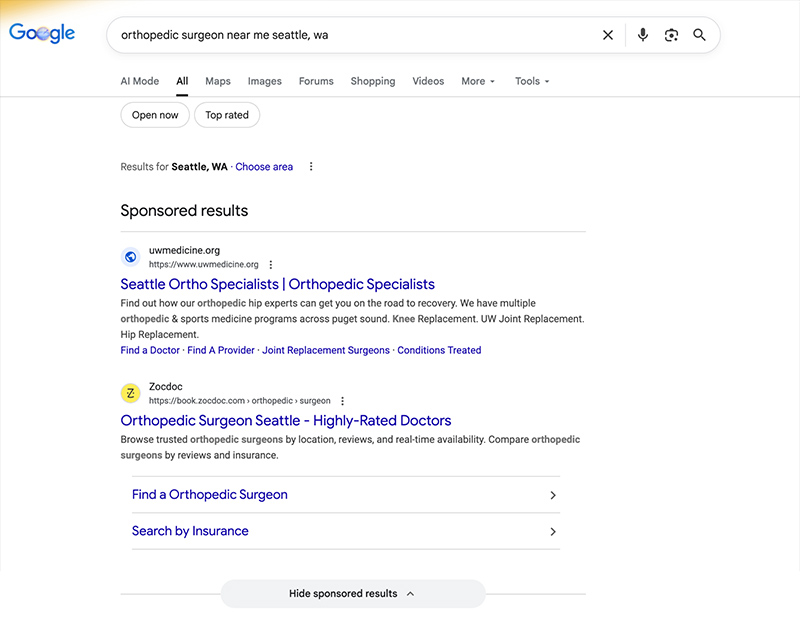
Search is essential. We’re not arguing against it. We’re arguing against it being the only thing.
When the rest of the ecosystem is working, something measurable happens: patients stop searching generic terms like “orthopedic surgeon near me” and start searching your hospital by name, often with the specific service attached. That shift is one of the clearest signals that your marketing is connecting patients with the services you’re building, not just capturing whatever demand already existed.
Even if they do leave out your hospital or health system name, you’re still influencing them to click through to your ad instead of a competitor when you’ve already made them familiar with that brand.
Search campaigns also become more efficient inside a connected ecosystem. Click-through rates go up because patients recognize your name from other touchpoints. Cost-per-click goes down because you’re competing less on generic terms. Intent CTR (the rate at which clicks turn into meaningful actions like calls or appointment bookings) outperforms healthcare benchmarks. In our experience running these campaigns, a connected approach consistently beats the industry baseline of around 3.15%.
The Metric That Actually Matters
If you take one thing from this post, make it this: the best indicator that your hospital digital marketing strategy is working isn’t the click-through rate on any single channel. It’s how well the whole connected system works together to get the right patients to the service lines you’re trying to grow.
Branded search volume is one signal. So is brand lift among exposed vs. unexposed audiences. So is the shift from generic searches (“orthopedic surgeon near me”) to named searches (“your hospital + orthopedics”). But no single number tells the whole story. The story is in the pattern: are more people in your service area finding their way to the specific services you’re building, through more pathways, more consistently?
And the data backs this up. Google research has found that users exposed to display ads are 155% more likely to search for brand-specific terms. Running display alongside search has been shown to lift conversion rates by up to 30% compared to search alone. The channels don’t just coexist. They compound.
Take one away, and the others get less effective. Run search alone, and you’re only reaching patients who already know what they need and where to get it.
The Hospitals and Health Systems That Grow Are the Ones Patients Search for by Name.
We work with hospital systems where paid media delivers eight-figure impression volumes across search, programmatic, social, digital out-of-home, and contextual medical placements. Campaigns where every channel has a defi ned role, a specific audience, and a metric that ties back to the patient journey.
The ones that work best aren’t the ones spending the most on search. They’re the ones where a patient can’t get through a week without seeing the system’s name in a few different contexts, so that when they need an orthopedic surgeon or a cardiologist or a primary care doctor, there’s no decision to make. The search is just a formality
That’s what a hospital digital marketing strategy is supposed to do. Not just capture demand. Build the kind of trust and familiarity that connects the right patients with the right services, before they even know they need them.
