


He sent his VP of engineering to scout Michigan auto suppliers to see if their existing products (backup cameras, small electric motors, battery systems for things like windshield wipers) could be repurposed for drones. Turns out they could.
There’s an opportunity here. And not just for the companies already building drones.
The Short Version
If you haven’t been following the drone space closely, here’s what’s happening.
DJI, the Chinese manufacturer, makes at least 80% of the hobbyist and commercial drones Americans fly. Recent federal restrictions on new DJI models have created an opening for domestic manufacturers that didn’t exist a few years ago. As the Times puts it, “companies are scrambling to build a supply chain from scratch, and states are vying to be at the center of it.”
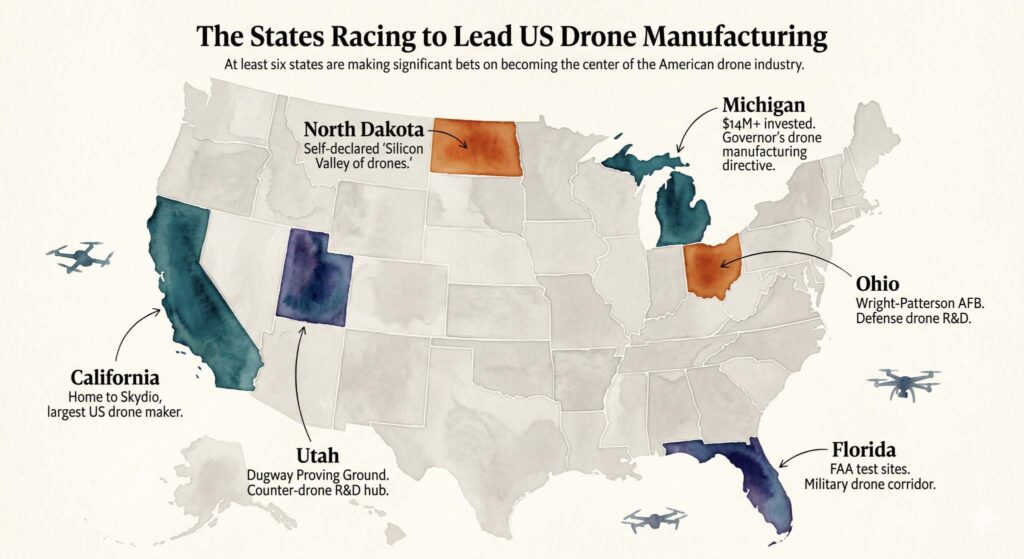
The numbers are real. The market for American-made unmanned aerial systems (UAS) is projected to grow from about $5 billion this year to more than $50 billion by 2030. States are competing to attract manufacturers: Michigan spent at least $14 million in 2025 on its drone
industry, and Governor Whitmer issued an executive directive to scale up drone and electric plane manufacturing. Florida, California, Utah, Ohio, and North Dakota are making similar bets.
Why Are We Having Thoughts?
We’re not drone engineers. We can’t design a motor or write autonomy software.
But we are an aerospace marketing agency based in Pasadena, which means we’re surrounded by this world every day. And we’ve done some work in the space.
Caltech’s Center for Autonomous Systems and Technologies is down the road, doing genuinely wild work on autonomous flight. (They helped build the helicopter that flew on Mars.) JPL is right there. We ran the City of Pasadena’s Deep Tech campaign to attract more companies like these to the area, because Pasadena has been quietly building one of the country’s deepest aerospace and robotics ecosystems for decades.
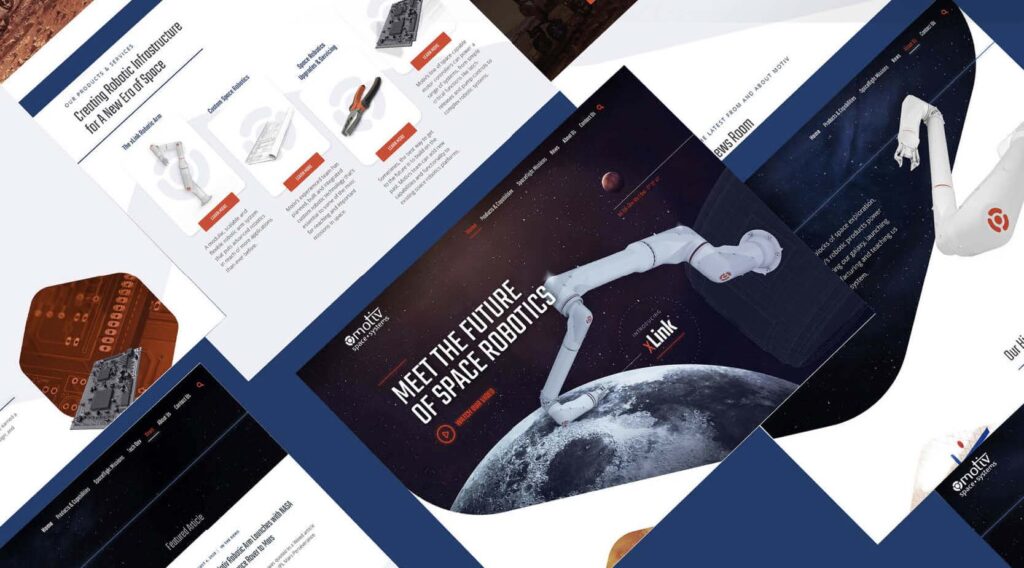
We’ve also done the work. We helped Motiv Space Systems, a Pasadena company that built the robotic arm on the Mars Perseverance rover, go from being perceived as a subcontractor to being recognized as a full industry partner. Their brand awareness increased 128% year over year. They made the Wall Street Journal and Forbes. Their project pipeline grew substantially ahead of internal goals. The technology was always there. The visibility wasn’t.
We also helped a California-based defense contractor expand into the UAV support market nearly a decade ago. They were ISO certified, AS9120B rated, with decades of experience supplying mil-spec protective equipment to the military and aerospace industry. They saw the commercial drone market forming and asked us a straightforward question: could they build a brand for drone operators? They already knew how to make the product. What they needed was a brand identity, an eCommerce channel, and a way to reach customers they’d never marketed to before.
We built it, launched it, and they acquired customers at a positive return.
So when we read that Times piece, what jumped out wasn’t the supply chain gap. It was the findability gap. Miao’s “zero to one” problem isn’t just about parts. It’s about visibility. There are US manufacturers right now with capabilities that translate directly to drone production, but they’re not showing up for it. And the drone companies trying to build a domestic supply chain can’t find them.
It works the other direction too. Drone manufacturers need customers: defense agencies, municipalities, utility companies, agricultural operations, logistics firms. A lot of these buyers have never purchased a drone before. They don’t have a way to evaluate competing products. And most of the brands they’d be choosing between didn’t exist three years ago.
We’ve spent 15 years helping aerospace and defense companies navigate exactly this kind of market. Here’s what we’ve learned.
1. The Best Product Doesn’t Automatically Win.
We’ve worked with aerospace companies that had genuinely global capabilities but were perceived as small regional players. The perception was costing them contracts they should have been winning. The Motiv story is a perfect example: they were building hardware for NASA, and the industry still saw them as a parts vendor. The technology wasn’t the problem. The gap between what the company could do and what the market knew about was the problem.
Look at the drone companies that have broken through so far. Shield AI didn’t market itself as “another drone company.” They led with AI-powered autonomy, which gave defense buyers a clear reason to pay attention. Red Cat won the Army’s Short Range Reconnaissance contract not just because their hardware was good, but because they built a brand that was credible enough to beat the incumbent. Positioning mattered as much as product.
2. Niche Buyers Need Niche Strategies.
A military program offi cer evaluating reconnaissance drones has almost nothing in common with a city transportation director exploring bridge inspections. The procurement processes are different. The trust signals are different. The timelines are different. Companies that try to talk to both audiences with the same message tend to underwhelm both of them.
3. Your Website Is Doing More Work Than You Think.
In traditional aerospace, relationships get built at the Paris Air Show, MRO Americas or Sea-Air-Space. The drone industry is still building its version of those events. In the meantime, program officers and procurement teams are doing their research online, like everyone else. We’ve seen a lot of drone company websites that read like they were built by the engineering team over a long weekend. (No judgment. We’ve been there.) But the companies with clearer stories are winning opportunities that the companies with better products are missing.
And here’s the part that’s changing fast: those buyers aren’t just Googling anymore. A product manager looking for a domestic supplier is just as likely to type “find me four suitable US domestic manufacturers for this drone motor stator” into ChatGPT or Perplexity as they are to search Google.
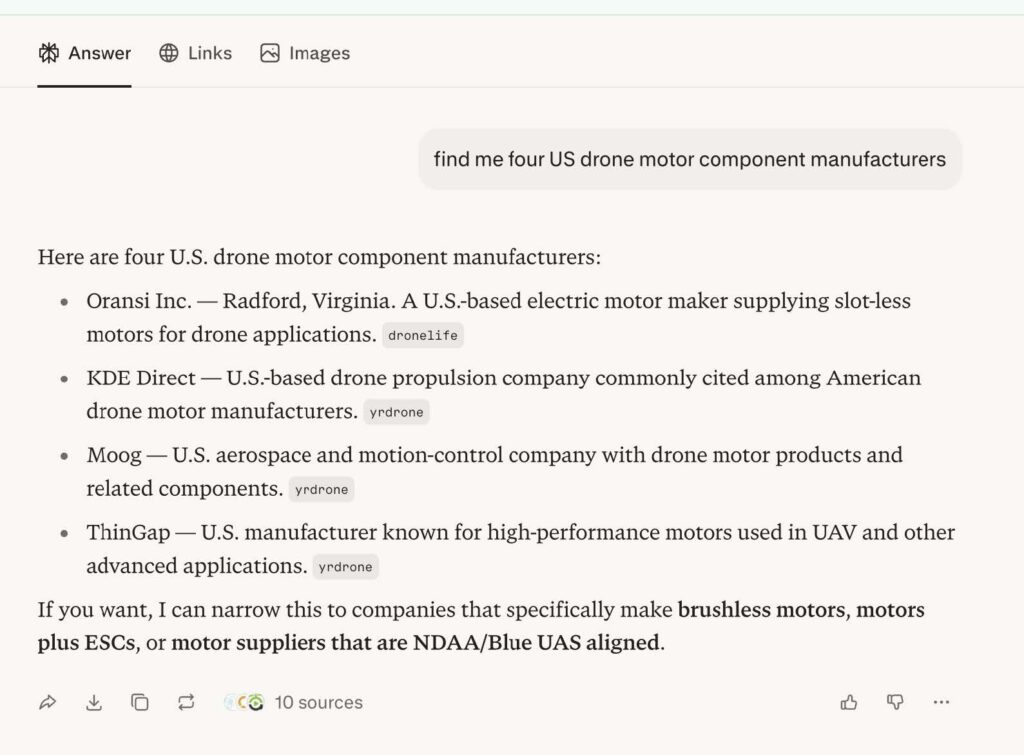
Your website needs to be understood by AI-driven search, not just traditional search engines. That’s a marketing skill that didn’t exist three years ago, and most companies are still catching up to it. The ones that figure it out early are already pulling ahead.
4. Consolidation Is Coming, and It Rewards Early Movers.
Right now there are dozens of drone companies competing in overlapping categories: defense, inspection, delivery, agriculture, infrastructure. In three to five years, each of those categories will narrow to a handful of players. That’s what happens in every aerospace vertical. The companies that have clear brand positions when consolidation hits will survive. The ones still figuring out their story will get acquired at a discount, or quietly disappear.
5. The Supply Chain Window Is Real, and It Won’t Last.
The Times article describes Detroit Manufacturing Systems, an automotive supplier that makes center consoles for Ford trucks, now hunting for drone contracts through a smaller-scale arm called Kinetyc. Textron recently partnered with Brunswick (yes, the boat company) to turn existing boat hulls into autonomous military drone vessels. These companies already have the
manufacturing infrastructure, the workforce, and the quality systems. What they need is a way into a new market.
If you’re an existing manufacturer with capabilities that translate to drones, the opportunity is right now. A clear digital presence, content that connects your manufacturing expertise to what the UAV industry needs, and visibility at the right events could put you in front of buyers who are actively searching for you. More suppliers will show up eventually. The ones who show up first will have an advantage that’s hard to replicate.
The Quiet Race
The headline story in the US domestic drone industry is about manufacturing: who’s building what, where, and how fast. That’s the exciting part, and it’s impressive to watch.
But there’s a quieter competition happening alongside it. It’s the race to build the brands, the reputations, and the market positions that determine which of these companies are still around in five years.
The “zero to one” problem won’t last forever. As Miao told the Times: “We want to see a future that’s 12 to 18 months away where there are maybe not 150 but 15 options” for domestic components. The ecosystem will fill in. Suppliers will emerge. Competitors will multiply.
When it does, the advantage shifts from “we exist” to “people know who we are, they trust us, and they understand why we’re different.”
The companies working on that part now, while the field is still open, will be the ones setting the terms later.
