



Defense procurement teams and MRO buyers are changing how they research suppliers. Instead of scrolling through search results, many now ask ChatGPT, Gemini or Google’s AI Overview: “Who supplies aftermarket parts for this aircraft?” If your company isn’t in that answer, you’re not on the shortlist.
This AI search optimization case study shows how Echo-Factory helped an aerospace and defense supplier, which provides parts, repair and overhaul for military and commercial aircraft, become the top answer in both Google and AI search. The result: more qualified leads, including buyers who found the company through ChatGPT and Gemini.
Key results at a glance:
- #1 in Google’s organic results and #1 in AI answers for priority aftermarket searches
- New leads every month from ChatGPT and Gemini, 7 in one month alone
- 34% better average Google position in 90 days
- +465% clicks to a key aircraft platform page after optimization
- +21% search clicks and +19% site visitors year over year
- 3,000+ companies identified researching the site in eight months
What is AI search optimization, and why does it matter in aerospace and defense?
AI search optimization is the work of making your company visible, accurate and recommended when buyers use AI tools instead of a list of links. It combines two disciplines:
Generative engine optimization (GEO) makes your company visible inside AI-generated answers from ChatGPT, Gemini, Perplexity, Microsoft Copilot and Google AI Overviews. Answer engine optimization (AEO) structures your content so those tools can quote a direct answer from it.
In aerospace and defense, the stakes are high for three reasons:
- Buyers search by platform and part.
- Shortlists are short. An AI answer typically names only a few suppliers. Being one of them puts you in the conversation before a competitor’s sales team is ever contacted.
- Sales cycles are long and high-value. One qualified inquiry from a defense agency or an OEM can be worth more than thousands of casual visits.
Classic SEO still matters. AI tools draw on the same signals Google uses: a fast, well-structured site, clear content and real authority. That’s why Echo-Factory runs hybrid GEO, building the classic foundation and layering AI-first optimization on top.
The challenge: strong brand, weak buyer visibility
The client is an established aftermarket supplier with several specialty subsidiaries, supporting a dozen-plus military and commercial aircraft platforms. Buyers who already knew the company found it easily. Everyone else mostly didn’t.
- Heavy brand dependence. Most search clicks came from people searching the company by name; even in spring 2026, branded searches still made up about 76% of clicks. Reaching new buyers remained the priority.
- Popular content, few buyers. Aircraft history articles drew huge audiences, roughly 674,000 search impressions a quarter across four posts, but most readers were enthusiasts, and the pages didn’t connect them to parts or repair services.
- Commercial pages buried. The core services page sat on Google’s second page.
- No AI strategy. Nothing on the site was structured for AI tools to understand which platforms the company supports or to quote it as a supplier.
The 12-month GEO/AEO roadmap
We ran the program in focused quarterly sprints. Each sprint laid the groundwork for the next, moving from audit to entities to performance to measurement.
-
1. Reposition around buyer language. We shifted the site’s SEO focus to “aerospace aftermarket” terminology, the phrases procurement and MRO buyers actually use, and built out dedicated pages for each aircraft platform the company supports.
2. Make every platform page answer-ready. We added question-and-answer sections answering what buyers ask before they reach out, such as which systems are supported for a given aircraft or whether the company is an authorized service center. Each is marked up with FAQ schema so Google AI Overviews, ChatGPT and Perplexity can pull from it.
3. Turn readers into buyers. On the high-traffic aircraft history articles, we added clear calls to action and made the aftermarket connection explicit, so both readers and AI tools understand the company supplies parts and repair for those aircraft. Tap-to-call phone numbers on platform and service pages make it easier for mobile buyers to call.
4. Measure what matters. Monthly reporting tracks rankings, calls and form leads, AI-sourced leads, and the companies visiting the site through visitor identification. Sales gets a follow-up list of interested aerospace and defense companies that haven’t reached out yet.
The results: #1 in Google and AI search, and more qualified leads
#1 in both organic search and AI answers
The aftermarket repositioning paid off where it matters most. The company earned the #1 organic ranking and the #1 AI-generated answer for priority aftermarket searches, appearing as the top source in Google AI Overviews and in answers from ChatGPT, Gemini and Perplexity.
Rankings climbed across buyer searches
In a single 90-day window, the site’s weighted average Google position improved by 34%. Commercial terms like “aerospace aftermarket services” jumped 17 places.
Platform pages became lead magnets
One optimized aircraft platform page grew from 26 to 147 clicks in a quarter, +465%, with a 9.74% click-through rate, the highest of any content page on the site. It is now the model for every other platform page.
AI search is now a lead source
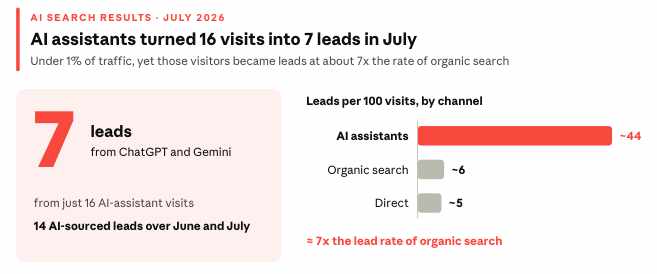
Search remains the biggest source of leads, but buyers now arrive from AI tools every month. In July 2026, seven leads began their research on ChatGPT and Gemini, steady with the month before.
Visibility into who’s researching
Visitor identification revealed more than 3,000 companies researching the site in eight months, and more than 450 in July 2026 alone. Most are aerospace, defense and aviation businesses, including a U.S. military branch and major OEMs that went on to contact the company. Companies that visited without reaching out go to the sales team as a follow-up list.
Frequently asked questions about AI search optimization
What is GEO for aerospace and defense companies?
GEO (generative engine optimization) helps aerospace and defense companies appear in AI-generated answers from tools like ChatGPT, Gemini and Google AI Overviews. For suppliers, that means being named when a buyer asks an AI tool who supplies parts, repair or overhaul for a specific aircraft or system.
How do I get my company to show up in ChatGPT and Google AI Overviews?
Start with an audit of how AI tools describe your company today. Then give them clear material to work with: one well-structured page per product or platform, short Q&A sections with FAQ schema, consistent company information across the web, and a fast, technically sound site. For this supplier, platform pages built this way earned the #1 AI answer for priority searches.
Do I need an AI search agency, or can my SEO team handle it?
An AI search agency adds the AI-specific layer: question research across ChatGPT, Gemini and Perplexity, answer-ready content and schema, and reporting that tracks AI citations and AI-sourced leads. Many aerospace and defense teams use an agency to set this up.
Can AI search really generate B2B leads?
Yes. In this case study, the client received new leads every month from buyers who started their research in ChatGPT and Gemini, 7 in July 2026 alone.
How is GEO different from traditional aerospace SEO?
Traditional SEO targets rankings for keywords on Google and Bing. GEO targets citations and brand mentions inside AI answers. Both rely on the same foundation, so we run them together as hybrid SEO.
How long does it take to see results?
This client’s average Google position improved 34% within a 90-day reporting window, and AI-sourced leads appeared as platform pages and aftermarket content were optimized. Timelines vary with competition and site size.
What does an Echo-Factory GEO/AEO engagement include?
An SEO and GEO readiness audit, a 3- to 12-month project plan, technical SEO, platform and Q&A content, structured data, and reporting that tracks rankings, leads, AI referrals and the companies visiting your site.
Need help with AI search? Find out if your company is in the answer
Echo-Factory helps aerospace, defense and advanced manufacturing companies win visibility in Google and AI search. Every engagement starts with an SEO and GEO readiness audit that shows where you stand today in Google, ChatGPT, Gemini and Perplexity, and which opportunities will move the needle fastest.
